Or… How the “Lesbian Simulator” reclaims normality through satirical tropes, celebrating queer joy without reducing the LGBTQ+ experience to a narrative of hardship.
By Una Bartusevičiūtė
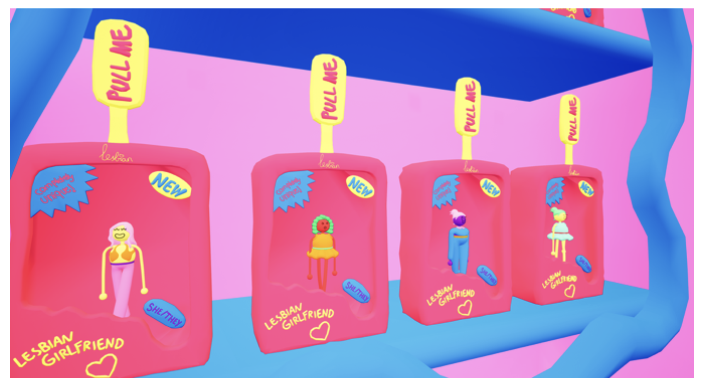
To start with a personal anecdote, as one does, I volunteered at the Dutch Film Festival (Nederlands Film Festival, or NFF in short) this year and served as the festival's (proud) assistant location manager at the Kinepolis Cinema and as a production assistant at the Municipal Theater Utrecht. During my time there, I saw many great films by established and emerging Dutch filmmakers, along with other digital interactive installations and experiences. The one that stood out most was the “Lesbian simulator,” which, as the name suggests, gives audiences the chance to immerse themselves in queer culture and everyday life.
The “Lesbian simulator” is a VR experience by Dutch queer digital artist and director Iris van der Meulen that premiered at IDFA in 2025 and has since been shown at numerous art festivals worldwide. Most recently, it was exhibited at the Dutch Film Festival (NFF), held in Utrecht from September 25 to October 2, 2026.
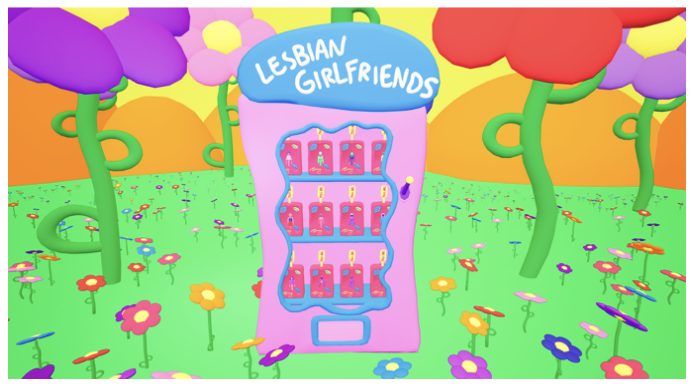
According to the artist, the work aims to evoke the lesbian experience for queer and non-queer people alike, particularly helping the latter understand queer life. In this roughly 40-minute experience, users create an avatar and get a girlfriend (who, naturally, comes from a vending machine, as most girlfriends do). They take her on dates and navigate queer dating, while also facing discrimination. For example, while dining at a restaurant and holding hands, nearby people stare and make inappropriate comments that grow louder as the digital environment becomes increasingly distorted. These encounters aim to show people from heteronormative backgrounds, who may be unfamiliar with everyday homophobia, that it remains part of society, even in accepting countries such as the Netherlands, where same-sex marriage has been legal for more than 25 years.
While the artist's intent may seem straightforward, I argue that it is, in reality, less clear-cut. Although the work is undoubtedly representational, it does not reach its intended audience and therefore does not effectively expose heteronormative society's blind spots regarding the LGBTQ+ community or discrimination, as other reviewers have argued. Rather, given its positionality, it offers queer people a space to feel represented. To support this claim, I will examine the work through a few key ideas: the concept of normality in cultural studies; the use of queer defiance in film studies; positionality and intersectionality.
In her press kit, the artist reflects on hearing people say, “I have nothing against gay people, as long as they act normal ,” and then asks, “What does acting normal mean?” This is one of the ideas she aims to challenge in her work. Building on that, I would also ask, from a cultural studies perspective: What does it mean to be normal? Who is considered normal, and who gets to decide? How is normal portrayed and understood in society?
Titchkosky defines the normal as a referential system for sense-making rather than a pre-given or natural condition of existence, emphasizing that the normal is not static but depends on intersectional factors, including group, context, time, and place (Titchkosky, 2015). Here, I distinguish between two distinct forms of normality: first, hegemonic assimilationist normativity, which serves as the work's didactic target; and second, a vernacular, referential queer normativity. The former is evoked by the idea of “gay people <…> act[ing] normal ” and demands that queer people conform to heteronormative society's baseline for normality. The artist's didactic intent challenges this baseline, exposing how fragile this tolerance is when everyday affection (such as the supposedly crazy idea of women holding hands) provokes hostility and distorts the environment. At the same time, the latter form of normality also emerges, drawing on Titchkosky's definition of the normal . This means that the simulator builds a world grounded in reclaimed stereotypes, social media tropes, and self-referential satirical humor, including references to Cate Blanchett, veganism, and emotionally entangled exes who remain best friends. While these codes may remain illegible and confusing to non-queer participants, for those within the community, this vernacular normal transforms the experience from a didactic lesson into a representational space that mimics what appears on social media and within inner queer circles.
The VR experience draws on ideas from New Queer Cinema to help community members feel represented. New Queer Cinema centers unapologetic defiance and rejects both mainstream positive images and narratives of tragic victimhood. Historically, mainstream media has depicted queer art through tragedy, suffering, passivity, and victimhood. In contrast, New Queer Cinema embraces irreverence, humor, and defiance, rejecting assimilationist standards that demand people act normally in a heteronormative sense (Aaron, 2004). Thus, while the “Lesbian simulator” acknowledges everyday acts of (not-so-subtle) homophobia, it does not let them define the queer experience. Instead, it celebrates the beauty of queerness through satirical jokes, moments of pride, and familiar, reclaimed tropes, helping community members feel represented. The reclamation of tropes can be understood through the concept of stereotypy , defined as a strategic, self-reflexive practice in which queer and marginalized creators deliberately use caricatures and tropes not to reinforce them, but to deconstruct them, reclaim agency, and foster in-group recognition (Wimbley, 2018). The VR experience draws on stereotypes established presence in media to connect with its queer audience. At the same time, it incorporates homophobia and less beautiful aspects of queer experience, such as questioning the need to “come out”: users repeatedly announce that they are gay and witness the reactions of the people they come out to. On the whole, the work is a clever example of acknowledging hardship without falling into victimhood, which is why I suggest it has been so successful at art festivals around the world; Nevertheless, as I will explain further, this may also limit its reach to a wider audience.
Positionality and intersectionality are central to the work's success among LGBTQ+ people, yet limit its reach among heteronormative audiences. I use positionality to describe how one's social location shapes one's worldview and, in turn, how one sees and interacts with the world. This idea works alongside the more granular concept of intersectionality, which focuses on the mutual co-construction and simultaneous operation of gender, race, class, sexuality, and other axes of significance, including age, nationality, and religion (Wekker, 2016). For queer participants, their positionality helps them recognize the work's insider tropes, social media references, humor, and stereotypy . Queer users greatly enjoy these elements, and although they do not necessarily prevent people outside the community from understanding the work, they make the experience more accessible and enjoyable for queer audiences. At the same time, they can overshadow the work's original intent as a didactic educational tool. This is especially true when considering Wekker's intersectional framework, in which sexuality does not operate in isolation but interacts with age, nationality, context, and popular culture. People attending the NFF festival in Utrecht are therefore already a highly selective group, with the means, interest, and subcultural awareness to book VR time slots (which sold out almost instantly because of the huge community interest sparked at the International Documentary Film Festival Amsterdam, or IDFA). Beyond the art festival, the work was also exhibited at World Pride in Amsterdam. While this is positive, audiences who attend Pride and are interested in this kind of experience are naturally less likely to come from highly heteronormative backgrounds. Hence, niche references not only disorient and distance heteronormative audiences from the work's central aim of “exposing blind spots” in queer life; they also prevent these audiences from experiencing the work in person, as it is booked out by LGBTQ+ users, who feel represented within it, and shown in selective venues. I therefore suggest that intersectional positionality helps explain why queer audiences occupied the space and booked all the slots, displacing the artist's theoretical non-queer target audience.
From my point of view, this is not a negative aspect of the work, as this kind of representation needs to be more visible in society. However, if the artist aims to familiarize heteronormative audiences with everyday discrimination, I think a different approach is needed, one that democratizes the content through universally accessible venues, rather than limiting it to people with specific geographic, financial, academic, or other advantages. That said, I personally believe it is entirely acceptable if the work does not take this approach. In that case, its focus should shift from familiarizing heteronormative audiences with homophobia to celebrating queer joy.
By and large, the “Lesbian simulator” was intended as a space where audiences could experience daily life through the lens of the artist's own experiences. It aimed to expose the blind spots in everyday moments of homophobia and the hardships of queer life. In reality, though, it became a space for joy, representation, and subversion within the queer community; a celebration of queer life and the hardships people endure without resorting to a victimhood narrative. It achieves this through the referential normal , where inside jokes and stereotypes rely on queer cultural literacy, reflecting the positionality and intersectionality of LGBTQ+ community members and, in turn, the simulator's users.
And so… I believe this work shows that queer art does not need to educate dominant society to be successful. This supposed detour from the artist's original intent to educate heteronormative society (or, in other words, cis straight white men) is not a flaw. I think it creates a space where queer individuals can feel represented, one the artist Iris van der Meulen has built so beautifully, and find collective joy and self-recognition within the LGBTQ+ community.
Bibliography:
Aaron, Michele. “1. New Queer Cinema: An Introduction.” In New Queer Cinema , by Michele Aaron. Edinburgh University Press, 2004. https://doi.org/10.1515/9781474463768-004 .
Lesbian Simulator . nd Accessed October 5, 2026. https://www.lesbiansimulator.nl/ .
Tanya Titchkosky, “Normal,” in Keywords for Disability Studies , ed. Rachel Adams, Benjamin Reiss, and David Serlin (New York: NYU Press, 2015), 130–32
Wekker, G. (2026). “Borders and Bridges: Gloria Anzaldúa, Intersectionality, and Interdisciplinarity.” Doing Gender in Media, Art & Culture. A Contemporary Guide to Gender Studies, pp. 43-58. Routledge.
Wimbley, Karin D. “Stereotypy, Mammy, and Recovery in Cheryl Dunye's The Watermelon Woman .” In Sisters in the Life , edited by Yvonne Welbon and Alexandra Juhasz. Duke University Press, 2018. https://doi.org/10.1215/9780822371854-013 .
Add comment
Comments