Written by Zlata Medvedeva
A movie about a woman confronting the struggles of motherhood and the loss of a child, all while living apart from her husband – a Latin tutor, who turns out to be William Shakespeare.
By the impressions of many people in the industry, Hamnet is considered to be one of the best movies of the year, distinguished by its artistic visuals, the cinematography, and the emotional impact on viewers. Directed by Chloé Zhao, the director of the Oscar-winning Nomadland, it is based on the novel Hamnet , written by Maggie O'Farrel in 2020. They worked on writing the film's screenplay together. Even though the film is sometimes promoted as showing the origin behind the creation of Shakespeare's Hamlet , the book is completely fictional and only sad to ponder how this tragedy might have come to life, following the events of Shakespeare's son's death at the time.
The movie, as well as the book, focuses on Agnes and her life since she has married William. The picture stars Jessie Buckley as Agnes Hathaway, Paul Mescal playing William Shakespeare and Emily Watson as William's mother .
Being spiritual and closely connected to nature, Agnes feels different from other people; this is what creates their connection with William. Will, who is not named as Shakespeare almost by the very end, has a desire to write and to create. His wife, recognizing his aspirations, wants him to look for opportunities, as well as a better place to develop. Therefore, she lets William leave to work in London and agrees to raise the children alone, in his parents house. Their separation forms an overwhelming distance that they struggle to overcome, not being able to share the most tragic experiences of their family with each other.
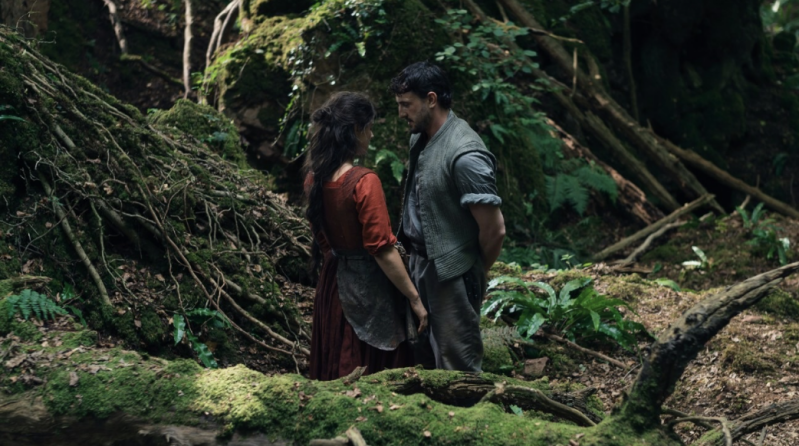
The events of the story unravel pretty fast, thus, at times, viewers are fully immersed into the characters' experiences while at others, they barely connect with them. For me, this has created a dissonance, where the movie rapidly goes through the development of the characters and their relationship, but then proceeds to the most tragic and emotionally dense events. This was, we do not have time to get used to William and Agnes being together, and their relationship does not seem developed enough for us to witness Agnes giving birth to their first child in the woods. At the same time, the spectacular actors' performance simply makes it impossible not to have compassion for the characters', as the emotions they convey are extremely deep and precise, although the lack of attachment, which stems from rushing the bonding process of the couple, results in a certain unnatural feeling in these episodes.
The unconditional tragicness of the theme of child loss together with the highly emotional and tense scenes create what this movie is both loved and judged for by spectators: it positions you to live through all the characters' most painful experiences and deal with the trauma in sync with them.
The main endeavor of this movie, in general, is an attempt to “conquer death”. Starting from the legend about Orpheus and Eurydice, told by William when he met Agnes for the first time, in which Orpheus tries to save Eurydice from the underworld, but fails to do so, breaking a condition of not looking at her until they reach the upperworld. This is сontinued when Agnes, with her clairvoyant abilities, had a vision that one of her children will die and when one of the newborn twins didn't breathe, Agnes denied accepting that the baby was dead and kept her until she woke up. The theme of "cheating" death is brought up again when Hamnet, Will and Agnes' son, who gives name to the movie, who gives name to the movie, tries to bring upon himself the illness that of his twin sister, mirroring their continued efforts of disguising themselves and switching themselves in front of others, Death itself as well. For the rest of the movie, Agnes and William seek how to defeat death and overcome this loss, which feels unbearable. And if Agnes is emotional and suppressed by this trauma, William finds a way to grieve about Hamnet by staging the tragedy of Hamlet, which also immortalizes the image of his son.
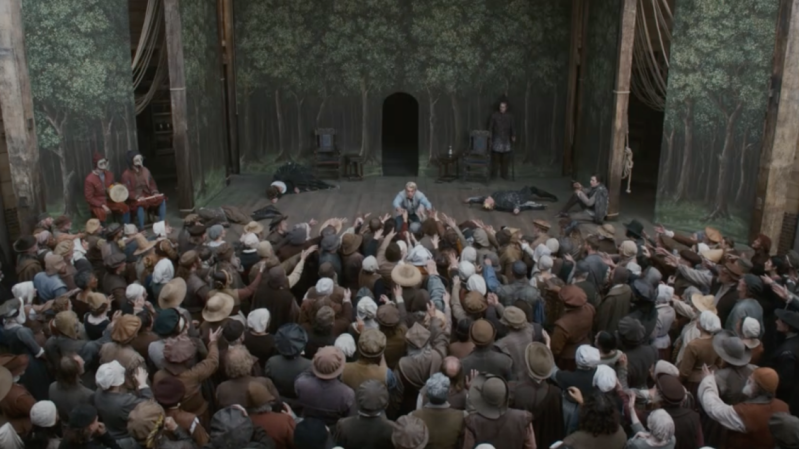
The final scene thus was the most moving for me. When the character of Hamlet is dying on the stage, Agnes, full of sympathy and perceiving him as her passed away son, reaches the actor with a hand. The crowd, touched by the performance, then follows the gesture, and people stretch out their hands towards Hamlet. Accompanied by Max Richter's “On the Nature of Daylight”, makes the scene exquisitely emotional and affective without any words pronounced. The feeling of shared grief and compassion that resonates with the personal tragedy of William and Agnes, turns out to be especially affective and powerful.
All in all, I find this movie genuinely good in many aspects. It is hard to argue that the actors' performance in the movie is not outstanding. The range of emotions exposed by Jessie Buckley is truly unbelievable, and feels highly realistic and convincing. Although Paul Mescal's acting is delicate, it is particularly accurate. The visuality of the movie is properly built to convey a specific mood. Nevertheless, the noticeable difference of depth of various scenes throughout the film, seemed quite challenging for me. The tragic and tense events of the movie that are shown in detail, do strongly encourage you to empathise with the characters and identify yourself with their experiences. However, due to the lack of connection to the characters, which wasn't properly constructed by the movie in advance, these episodes indeed feel a bit out of place and manipulative. For me this imbalance of narrative became an obstacle to connect emotionally to the movie, to experience it fully and to have a positive impression of it in the end.
Add comment
Comments