“Art is in the eye of the beholder.” Emerald Fennell’s retelling of the classic story is a controversial, yet captivating piece of art.
Written by Susan Dijker
One of my favorite parts of going to the cinema to see a movie is hearing the collective reactions from the audience. Watching “Wuthering Heights” in a full theatre was an experience of its own; Everyone laughing at moments of ridiculousness, gasping at shocking one-liners, and seeing all the heads in front of me look to each other as Heathcliff returns to Cathy with his new look. Whether you like the film or not, Emerald Fennell’s adaptation of Emily Brontë’s book makes audiences feel the full range of emotions.
“Wuthering Heights” follows the tragic love story between Cathy (played by Margot Robbie) and Heathcliff (Jacob Elordi). When Heathcliff is ‘adopted’ by Cathy’s father the two grow very fond of each other, eventually falling in love. But when a rich bachelor moves into the house next to them Cathy chases wealth and status, driving Heathcliff away for several years. When he finally returns, their lives are turned upside down.
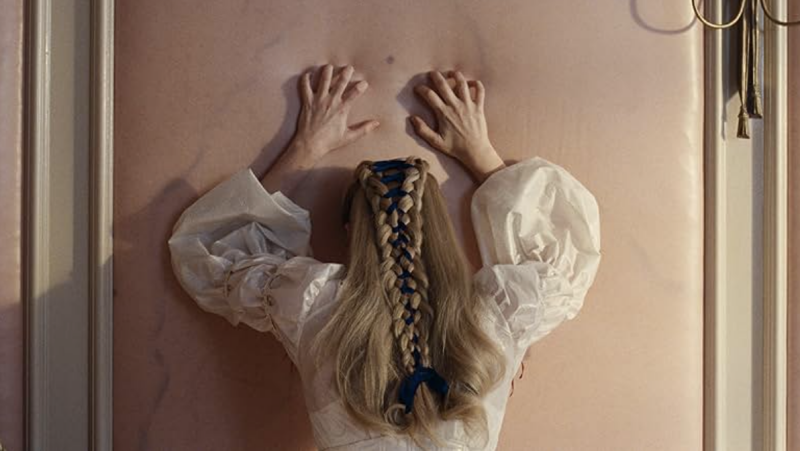
As controversial as the release has been, this film feels like it was made for me personally. I have not yet read the book by Brontë and I think judging this film as a standalone piece of media works in its favor. So seeing it as such I really enjoyed it and was very impressed visually, “Wuthering Heights” is one of the most gorgeous films I have seen in a long time. I think it is worth seeing just for the beautiful shots of the fog covered English landscapes and the amazing costume and set design. The mansion where most of the story takes place bears strong resemblance to the German expressionism of the twentieth century, portraying the absurd and tormented inner world of the characters as well as director Emerald Fennell’s personal experience of the book. The eerie soundtrack by Charlie XCX adds to this sinister feeling of torment belonging to the expressionist movement. The landscapes, however, are reminiscent of impressionist paintings like those of Monet. In this sense, between the carefully crafted soundtrack and the stunning visuals, the film forms into an impressive piece of art.
We should address the elephant in the room here: the casting of Heathcliff. In the book he is, although this has been debated ever since its release in 1847, a man of color, which makes for a lot of the effects and meaning of the story. Choosing to cast the white Jacob Elordi in the role has thus ruffled some peoples feathers. Watching the opening of the film it becomes quite apparent that Heathcliff, even though now being played by a white man, is not a white character. While Heathcliff is made white, other characters like Nelly and Edgar have been casted so called ‘colorblind,’ being white originally in the book but not in the film. The film makes a great example of why ‘colorblind casting’ doesn’t really work. In stories such as these it is not simply about the skin color of a character, but about an embedded cultural and historical context. Early moments of Heathcliff in the film take on a much darker meaning in relation to his non-whiteness and the time in which the story takes place. Emerald Fennell has defended her choice of actor, by stating that because the book never explicitly mentions Heathcliff’s race one can only create a movie based on how they imagined it themselves while reading. In our current age of supposed progressiveness a choice like this, expectedly, stirs up a lot of conversation.

That being said, I do think that some space needs to be left for artistic freedom in adaptations. Controversy leading up to the release, as well as in the first reviews, is not just about the casting. A lot has also been said about the sensuality of Fennell’s reinterpretation. The book by Brontë does not contain any explicit sex scenes, this new film contains many. I can understand that as an admirer of a piece of media you might not want to see it altered, but then this adaptation will just not work for you. I think there is a beauty to this freedom of interpretation, that is inherent to art and creation. “Art is in the eye of the beholder.” What is art for, if not to be reinvented? Regardless of your personal feelings towards this specific retelling, I find it a bit harsh to link its quality to its likeness to the book. Movies like Clueless (1995), Easy A (2010) and Romeo + Juliet (1996) are all based on classic literary works, with very loose adaptation. So why is this such a problem for “Wuthering Heights”? Fennell has claimed to have made this film based on her experience reading the book as a teenager, so it makes sense that it’s not a highly intellectual interpretation. Rather it’s horny to an almost ridiculous level, not shying away from the explosive way things can be experienced during your teen years. The quotation marks around the title of Fennell’s “Wuthering Heights” signify, to me, that this is not going to be a book accurate retelling, instead it is an expression of the feelings evoked by the original piece of media, the personal experience of it brought to life.
My advice would be to watch this film with an open mind. Not comparing it too strictly to Brontë’s original book, but instead appreciating its artistic expression and honestly the fun and sexiness of it. And I promise that, regardless of how you relate to the narration, you will be in for two hours of visual spectacle!
Add comment
Comments